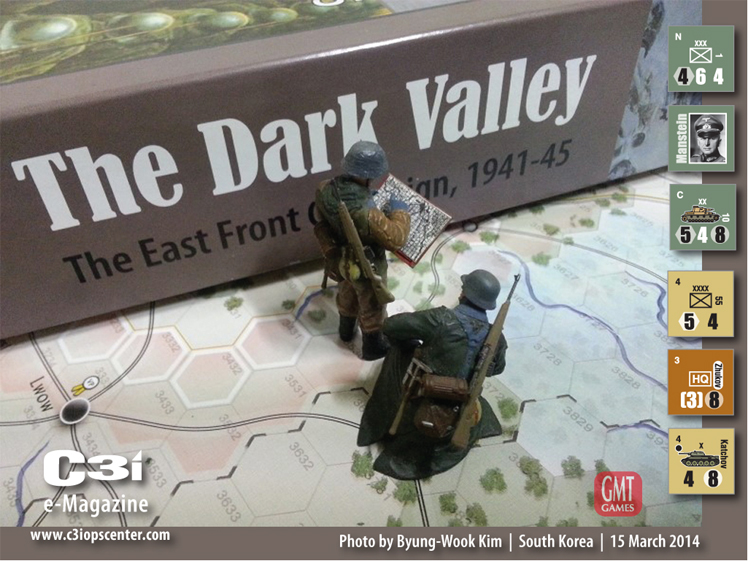
The same impulse that keeps people buying Eastern Front wargames – even when they already have more than they need — must be physiologically related to the one that keeps people designing them. Ted Raicer has designed a few, including Shenandoah’s iOS gem Drive on Moscow, as well as the card-driven games Stalin’s War and Barbarossa to Berlin. But that didn’t stop him from jumping back into the deep end of the pool with a division/corps-level game, The Dark Valley, released by GMT Games this summer and deposited on my doorstep a few days after that. I’m a sucker for this stuff, and despite the fact that I have everything from Avalon Hill’s old Stalingrad to GDW’s monster Fire in the East, and pretty much everything in between, I still pre-ordered this one the day I heard about it. When you’re this close to a subject, every new game becomes a re-examination of history, and assimilating a new set of rules and sheets of counters is a way to reflect on what you know about a period of history, and what others may have to teach you.
Ted Raicer does some reflection of his own in the Dark Valley designer’s notes. The rules and playbook are available for free online in pdf form, and I recommend you download the latter and scroll down to page 10, where Ted talks about going back to the drawing board once again, trying to alchemize the perfect Barbarossa from glossy paper and cardboard. The Euro craze has become so pervasive, and its logic so insurmountable, that you can almost see it as a foregone conclusion, an expression of basic truths so fundamental to existence that their expression is nothing less than a world asserting something that should have never been denied in the first place, like civil rights or universal suffrage. Elegant systems, abstracted mechanics, and relentless involvement of everyone at the table all the time, whether actively or passively, so that the gaming experience is one that is constant, interactive, and engaging – it’s a new understanding of tabletop play, and probably is no coincidence that it arrived shortly after the collapse of the Soviet Union dispelled several solar masses of noxious karma from our planet. Eastern Europe unchained, and gamers revitalized.
And then Ted Raicer goes and digs up an old design from the 1980s, builds a redoubt of odds columns, combat results tables, and terrain effects charts, and barricades himself in.
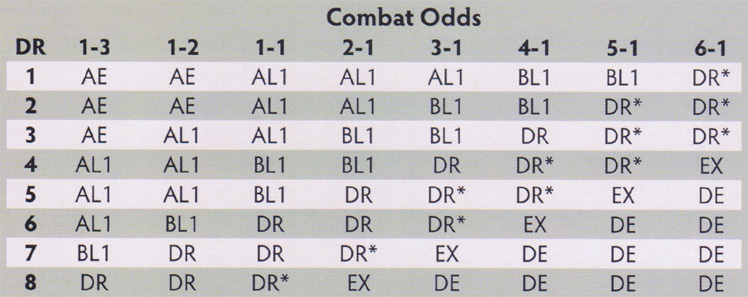
I couldn’t really come to any other conclusion when I first opened my copy of The Dark Valley, a two-map, 800-counter defense of orthodoxy and expression of counter-reformation sentiments that only hints at a recognition of the world that has developed since I once set up my counters, told my roommate to go make a sandwich, then go see a Cubs game and stay out for drinks afterward, while I figured out my War in the East move. No matter how you package it, making a game where each counter has a number on it, and each attack is an odds ratio, and there are about a bazillion of all of them, turns the gameplay experience into a solitary exercise in coercive arithmetic.
Which is just fine with me, by the way. Because while only the truly aberrant miss the social repression of past decades, the drive to involve everyone all the time in exquisitely balanced decisions about where to place this single worker to best harvest the wheat that the person standing to your immediate left was just about to plop his painted wooden marker on, is frankly a bit too progressive, and if you think about it a while, probably a bit dishonest as well. Because the worlds that gamers once created to express their imaginations were originally limitless, all-encompassing structures, always amenable to tearing down that wall and building a new room, or town, or continent. Want to roll up a talking rabbit with a laser gun? Please do. Whereas now, it’s your turn and your sorcerers have the Flying ability, which means they can move there, there, or there. Oh wait, and there too, I didn’t see that one.
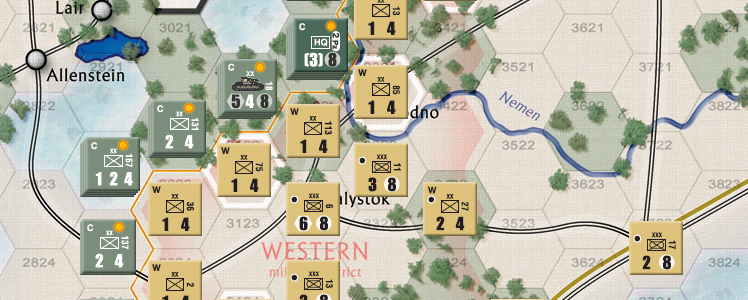
So when a friend of mine asked me to play a game of The Dark Valley over VASSAL, I felt like a cooper called to an urgent guild meeting, where we would debate the merits of dry-tight cooperage against the straight-staved craft of the white cooper. Don’t even think about selling me your newfangled plastic bins or corrugated cardboard. There is something fundamentally satisfying about getting a setup and immediately trying to break his numbers with your numbers. Once I got the Soviet setup, I spent the evenings of several days moving this unit here, then that unit there, testing the defenses before I replied with my opening setup and the game could begin. Four and four and two is eight, because the fours are actually three each since mech loses one factor attacking into forest. “I forgot that motorized units are doubled when attacking clear terrain on Turn 1!” I told my wife when she walked by one time and sort of slowed down a bit to look at the screen over my shoulder. “Uh huh,” she said, speeding up to do something more interesting, like fold laundry. But that’s the essence of the factor-counting experience that until about twenty years ago wasn’t seen as in any way retrograde. Only profoundly weird.
Ted Raicer isn’t retrograde. I don’t know if he’s weird. But he made a determined nod toward the bright, egalitarian future with his incorporation of chaos, which is gaming’s statement of principle that games shouldn’t be predictable because life isn’t, either. So while games already had a random element in the form of six-sided dice, a deck of cards had 52 sides, and you could draw pictures on them about actual history. Before you knew it, designers had embraced this ultimate representation of why things happened: because you drew a card that said it did, dummy.
The Dark Valley, true to its regressive roots, doesn’t use cards. Instead, it uses chits, and those chits tell you who can move, and how, and when. The chit-pull dynamic is a subversion of the “it’s my turn now because it was your turn before” reality that somehow seems rooted in the artificial stasis of 1960s TV serials. While Col. Mustard may have made his way to the library with the candlestick in due time, no one would have ever thought to then let him progress to the billiard room, and the cellar, and even the conservatory, before Miss Scarlett had a chance to throw down her lead pipe and walk off in exasperation. Which is what I’m sure my sister would have done when we were kids playing Clue if Ted Raicer had made her do chit pulls.
There is nothing revolutionary or even progressive about chit pulls, and if you were frantically trying to find a way to email me about this fact because you couldn’t imagine a whole article being written about a game with the premise that someone thought it was “innovative” because the central mechanic was invented about twenty years ago, you can pull yourself together. Somebody invented variable initiative a long time back, and whether it was Eric Lee Smith with Across Five Aprils, or Mark Herman with Great Battles of Alexander, or Mark Simonitch with The Legend Begins, I have no idea. The whole point is that you never know who is moving next, because the coffee mug you got back in college when you contributed to your local public radio station is now full of counters labeled “Move/Attack” and “Counterattack” and “3rd Pz” and some other stuff no one knew about back then, like Logistics. And you pull one of them out, and it doesn’t say what you wanted it to, and you’re pissed. Sorry, man – I’ll bet Zhukov had some bad days circa 1943, too.
But I’ve fooled you again, because The Dark Valley isn’t just about chit pulls. It’s about game mechanics making you do certain things, and not do others, and odds not being what you thought they were (to paraphrase Denny Green), and a whole bunch of other stuff that would tell anyone who was paying a half bit of attention that this isn’t a game from 1987. Instead, it’s about a bunch of learned lessons from decades of stuttering progress, just like the real world we live in. But somehow, it’s also about sitting in front of the game and counting one movement factor two movement factors, three movements factors, oh wait on Turn 1 mech “treats swamp as forest.” And then looking it up on the terrain effects chart and finding that there is no “swamp” terrain at all, but there is something called “marsh.” In that way, maybe it really is 1987 again.
I’m going to report on this game of The Dark Valley, not because it’s going to bring us closer to social justice, but because I want to tell you about how there are so many things a designer can do, and it’s easy to just breeze by all of this because look my panzer is in Leningrad. But how it got there is a story in itself, and Ted Raicer is a lot more clever than an episode of Bonanza. You can take my word for that.
_____________________________
The wonderful image at the top of this post originally appeared in GMT’s C3i magazine and was created by Byung-Wook Kim of South Korea. Just spectacular.

Discussion
No comments yet.